
JW Tech Strategies
I help growing companies identify when to scale organizational structure, infrastructure, and security – and when scaling would destroy them.
After 25 years of leading technology teams and writing extensively about scaling failures, I’ve learned that companies don’t fail because they make bad decisions. They fail because they make the right decisions at the wrong time.
AI is compressing these timelines. The window between scaling too early and scaling too late is narrower than it’s ever been. The organizations that survive are the ones that get the timing right – not the ones with the best technology or the smartest people.

The Two Ways Companies Destroy Themselves
Scaling Too Late looks like this: A startup that worked beautifully at 50 people starts cracking at 300. Leadership insists on preserving the “flat culture” that made them successful, eliminating management layers and resisting process. They call it empowerment. Their best engineers call it chaos – right before they leave. By the time leadership acknowledges the problem, they’ve lost institutional knowledge that took years to build.
AI accelerates this failure mode. When AI-augmented teams produce 2-3x the output at the same headcount, the coordination gaps that define “too late” show up sooner. The company that could operate without formal structure until 60 people now hits that wall at 35.
Scaling Too Early looks like this: A company with 20 employees builds infrastructure designed for 2,000. They implement enterprise security frameworks before they have enterprise revenue. They hire directors before they need directors. The overhead consumes resources that should fuel growth. They’ve built a mansion when they needed a foundation.
AI creates a new variant of this failure. Companies investing in enterprise AI platforms, MLOps pipelines, and AI governance frameworks for use cases that haven’t been validated. The investment feels strategic. The returns don’t materialize because the problem wasn’t infrastructure – it was premature complexity.
Both failures share the same root cause: leadership that couldn’t recognize where they actually were versus where they wanted to be. AI hasn’t changed this dynamic. It’s compressed the timeline for both failure modes and raised the cost of getting timing wrong.

Signs You’re Scaling Too Late
– Your “flat organization” has informal hierarchies that everyone knows but no one acknowledges
– Senior engineers are drowning in coordination work instead of engineering work
– You’ve lost more than one key person who cited “lack of growth opportunity”
– Decisions that used to take a conversation now take a month of meetings
– Your best people are training their replacements at other companies
– AI tools have increased individual output, but cross-team coordination hasn’t kept pace
– Your AI-augmented team of 25 has the coordination problems of a 50-person company
Signs You’re Scaling Too Early
– You have more process than product
– Your infrastructure costs are growing faster than your revenue
– You’ve implemented compliance frameworks your customers don’t require
– You have managers managing managers before you have teams that need management
– Your technical architecture could handle 100x your current load, but you can’t make payroll for six months
– You’ve invested in enterprise AI platforms for problems a well-crafted API call could solve
– You’re building MLOps pipelines before you’ve validated a single AI use case


Signs You’re in the Danger Zone
– Leadership disagrees on which problem you have
– You’re solving last year’s scaling challenge instead of next year’s
– Your technical decisions and organizational decisions are made by different people who don’t talk to each other
– Your AI productivity metrics look great but your team is quietly building workarounds under the surface
– Nobody can answer whether AI adoption is making your organization faster or just making dysfunction more efficient
AI Is Changing the Equation
Every scaling pattern I’ve studied over the past 25 years is being affected by AI adoption. Not replaced – accelerated.
AI compresses the scaling timeline. When AI-augmented teams produce more output at the same headcount, organizations hit structural inflection points sooner. The coordination gaps, the accountability breakdowns, the security exposure – they all arrive faster than historical patters would predict.
AI masks dysfunction. Teams use AI tools to work around broken processes more efficiently. The underlying problem persists, but it’s less visible because the workaround is faster. Leadership sees improving productivity metrics. The team experiences growing complexity under the surface.
AI creates new risk categories. AI-generated code introduces vulnerabilities at volume. Compliance frameworks haven’t caught up with AI-augmented development practices. Access controls desinged for human developers don’t account for the scope of AI tooling. And the knowledge concentration risk – a single developer shaping large portions of the codebase through AI-assisted work – is a new variant of key-person dependency that traditional assessments don’t detect.
The assessment methodology I’ve developed now includes AI-specific diagnostics alongside the traditional organizational and infrastructure evaluation. Because AI doesn’t change the fundamental equation – it changes the coefficients. The timing still matters most. The window is just narrower.
The Scaling Equation
Most business books tell you what to do. They assume you know when to do it.
That assumption destroys companies.
I wrote The Scaling Equation series because I kept watching smart leaders make smart decisions at exactly the wrong moment. The books follow Sarah Brennan, a DevOps leader who walks into organizations that look successful on the surface but are weeks away from catastrophic failure. The warning signs are always there. They’re always ignored.
I publish patterns and frameworks from this research weekly in The DevOps Leadership Brief, my newsletter for technical leaders navigating these exact challenges.
The Accountability Gap: Why Flat Organizations Fail at Scale examines what happens when companies refuse to scale their organizational structure alongside their growth. GlobalTech’s leadership eliminated management layers to preserve their startup culture. Within eighteen months, they’d lost their best engineers, botched their most critical product launch, and destroyed decades of institutional knowledge—all while insisting the “culture” was stronger than ever.
The Goldilocks Principle: Why Startups Die From Premature Scaling explores the opposite failure: companies that build for scale before they’ve earned scale. They implement enterprise solutions for startup problems, burning resources and creating complexity that actively prevents the growth they’re preparing for.
The DevOps Assessment Guide provides the diagnostic methodology I use in every engagement. Assessment must precede implementation. You cannot fix what you haven’t accurately diagnosed, and most organizations are treating symptoms while the disease spreads.
The diagnostic frameworks from the Assessment Guide inform everything I publish – from the four-question assessment methodology to the DevOps maturity spectrum. If you want to see these frameworks applied to current challenges including AI adoption, security scaling, and organizational timing, subscribe to The DevOps Leadership Brief below.
How We Can Work Together
Every company’s scaling challenge is different—but the patterns are remarkably consistent. Whether you need a second opinion before a critical decision, an honest assessment of where you actually are, or a partner to navigate the transition with you, the work starts in the same place: figuring out your timing.
Pattern Recognition at the Inflection Point
Architecture and infrastructure reviews when growth is outpacing what you’ve built. Organizational design conversations when your team structure no longer fits your company size. Technology due diligence before acquisitions, investments, or major platform bets. Board-level translation of technical scaling risks into business language.
This includes AI readiness assessment – evaluating whether your AI adoption is calibrated to your organization’s actual scale, or whether you’re investing ahead of validated use cases.
Diagnostic Assessment Using the DevOps Assessment Framework
A concentrated evaluation of your systems, infrastructure, security posture, and organizational structure against your actual growth trajectory. The assessment starts with four foundational questions:
– How do decisions get made about your technical environment?
– Where do those decisions stall or get lost?
– What has your team built around instead of resolving?
– What has AL made efficient that should have been eliminated?
You walk away with:
– A written diagnostic report mapping your accountability gaps, infrastructure maturity level, and security exposure
– A quantified workaround tax – the percentage of engineering time consumed by navigating organizational friction
– A 90-day action plan prioritized by risk and ROI
– A 12-month strategic roadmap including AI integration readiness
– An executive briefing document translating technical findings into business language
Assessment must precede implementation. You cannot fix what you haven’t accurately diagnosed.
Ongoing Strategic Partnership
For organizations actively navigating the shift from one stage of growth to the next. Scaling sequence planning, team development, security and compliance implementation, vendor management, and continuous pattern recognition as conditions change.
This engagement includes continuous diagnostic practices – the leading indicators, trend analysis, and regular calibration that replace periodic audits with ongoing organizational awareness. Including AI-specific metrics: the governance-to-velocity ratio, AI rewrite ratio, and knowledge concentration index.
Designed for growing companies between 50-500 employees who have outgrown one stage but haven’t yet built for the next.
The engagement scales to what you need—a single conversation, a half-day workshop, or an ongoing partnership. The goal is always the same: help you see where you actually are so you can make the right decision at the right time.

About
I’m Josh, the founder of JW Tech Strategies and a Marine Corps Veteran.
I’ve spent over 25 years in technology leadership – building infrastructure, leading engineering teams, and watching organizations succeed and fail based on decisions that seemed minor at the time. My career has taken me through wireless technologies, gaming, aerospace, cybersecurity, and multi-media/marketing – always in roles where I was responsible for making systems work and scale.
What I’ve learned is that technical problems are rarely just technical. The code, the infrastructure, the security posture – these are symptoms. The disease is almost always organizational: leadership that can’t see where they actually are, teams structured for a company size that no longer exists, processes designed for problems that have evolved.
AI adoption is adding a new dimension to these patterns. The scaling challenges I’ve studied for decades are being accelerated, compressed, and complicated by AI in ways that most organizations aren’t equipped to navigate. I write about this intersection – where established scaling patterns meet AI’s new variables – every week in The DevOps Leadership Brief.
I started writing about these patterns because I kept having the same conversations. Smart leaders, capable teams, companies with real market opportunity – all making the same timing mistakes I’d seen destroy previous organizations. The books in The Scaling Equation series aren’t abstract theory. They’re the patterns I’ve witnessed and repeatedly, documented so that others might recognize the warning signs before it’s too late.
Published Work
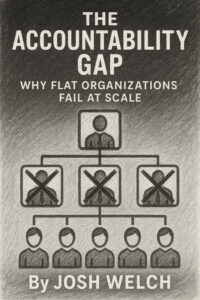
The Accountability Gap: Why Flat Organizations Fail at Scale
Sarah Brennan was the DevOps Manager who kept GlobalTech running. For eight years, she built the systems, developed the talent, and solved the problems that executives never saw. Then leadership decided to “flatten” the organization and eliminate management layers to preserve their startup culture.
They called it empowerment. Sarah called it chaos.
Within eighteen months, the company lost its best engineers, botched its most critical product launch, and destroyed decades of institutional knowledge—all while leadership insisted the “culture” was stronger than ever. Sarah documented every warning sign. She proposed solutions. She fought for her team.
They fired her anyway.
The Accountability Gap is a business fable about the most common—and most ignored—failure mode in growing companies: the refusal to scale organizational structure alongside business growth. Through Sarah’s story at GlobalTech, you’ll witness how flat organizations that work brilliantly at 50 people collapse catastrophically at 500.
Book One of The Scaling Equation Series – available on Amazon
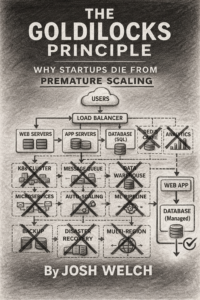
The Goldilocks Principle: Why Startups Die from Premature Scaling
CloudScale had 18,000 users, $3 million in annual revenue, and a product customers loved. They also had a board-approved $8 million infrastructure budget designed to handle 100 million users who didn’t exist.
Sarah Brennan watched a profitable startup rip apart a working monolith to build 50+ microservices, triple the engineering team, and burn through capital preparing for hypergrowth that never came.
When she raised the alarm, they called it small thinking. When the Series C failed and the company was acqui-hired for parts, nobody called it anything at all.
Book Two of The Scaling Equation Series – available on Amazon
The DevOps Assessment Guide: A Practical Framework for DevOps Leaders
You’ve just stepped into a DevOps leadership role. Now what?
You inherited a complex environment with pipelines you didn’t build, processes you didn’t design, and technical debt no one warned you about. Leadership expects results. Your team is watching. And somewhere in your organization, there’s a problem waiting to explode.
The pressure is real—but you don’t have to figure it out alone.
THE DEVOPS ASSESSMENT GUIDE is the diagnostic manual every DevOps leader needs but few have. Unlike other DevOps books that teach you what DevOps is or how to implement it, this book answers the question that matters most in your first 90 days:
What have I actually inherited, and how do I systematically evaluate it?
Assessment must precede implementation. – available on Amazon
The DevOps Leadership Brief
Weekly patterns, frameworks, and diagnostics for technical leaders navigating scale
Every Friday, I go deeper on the scaling patterns, DevOps assessment frameworks, and AI impact analysis that I can’t cover in a LinkedIn post.
What subscribers get:
– A weekly recap of the patterns I’ve shared on LinkedIn that week
– An exclusive deep-dive article on scaling timing, DevOps methodology, organizational dynamics, or security – with AI’s impact woven throughout.
– Diagnostic frameworks you can apply to your own organization immediately
– The assessment methodology behind The Scaling Equation, delivered in actionable pieces
No fluff. No pitches. Just the analytical frameworks I use in my assessment work, written for CEOs, founders, and technical leaders who’d rather see the patterns coming than clean up after them.